

ChatGPT now lets eligible businesses claim and manage their information, see how people discover them, and potentially interact with customers through AI. Here's what that means for your business, what it doesn't mean, and how to get started.
Think about how people look for businesses today.
Someone needs a new website, so they search online for website designers.
A homeowner needs a roofing contractor, so they compare local companies.
Someone shopping for a product reads reviews, compares prices, and asks questions before making a purchase.
For years, much of that discovery process has happened through search engines, business directories, social media, and company websites.
Those platforms are still important.
But there's another place people are increasingly turning to for information: AI assistants like ChatGPT.
Instead of searching several different phrases and opening multiple websites, someone might ask:
"What should I look for when hiring a digital marketing professional?"
Or:
"Can you help me compare local companies that provide this service?"
Or even:
"Which businesses offer this product, and what are the differences between them?"
That's part of what makes OpenAI's newly introduced ChatGPT Business Hub worth paying attention to.
On November 10, 2026, OpenAI announced Businesses in ChatGPT, a new beta offering that allows eligible businesses to claim their business profiles, manage certain information, and access insights about how people engage with them in ChatGPT.
For some eligible businesses, it also introduces a feature called a Business Agent, which can help answer customer questions directly within ChatGPT.
That's a potentially meaningful development for businesses of all sizes.
But before everyone rushes to claim a profile expecting an immediate increase in customers, there are some important details, limitations, and opportunities worth understanding.
Let's go through them.
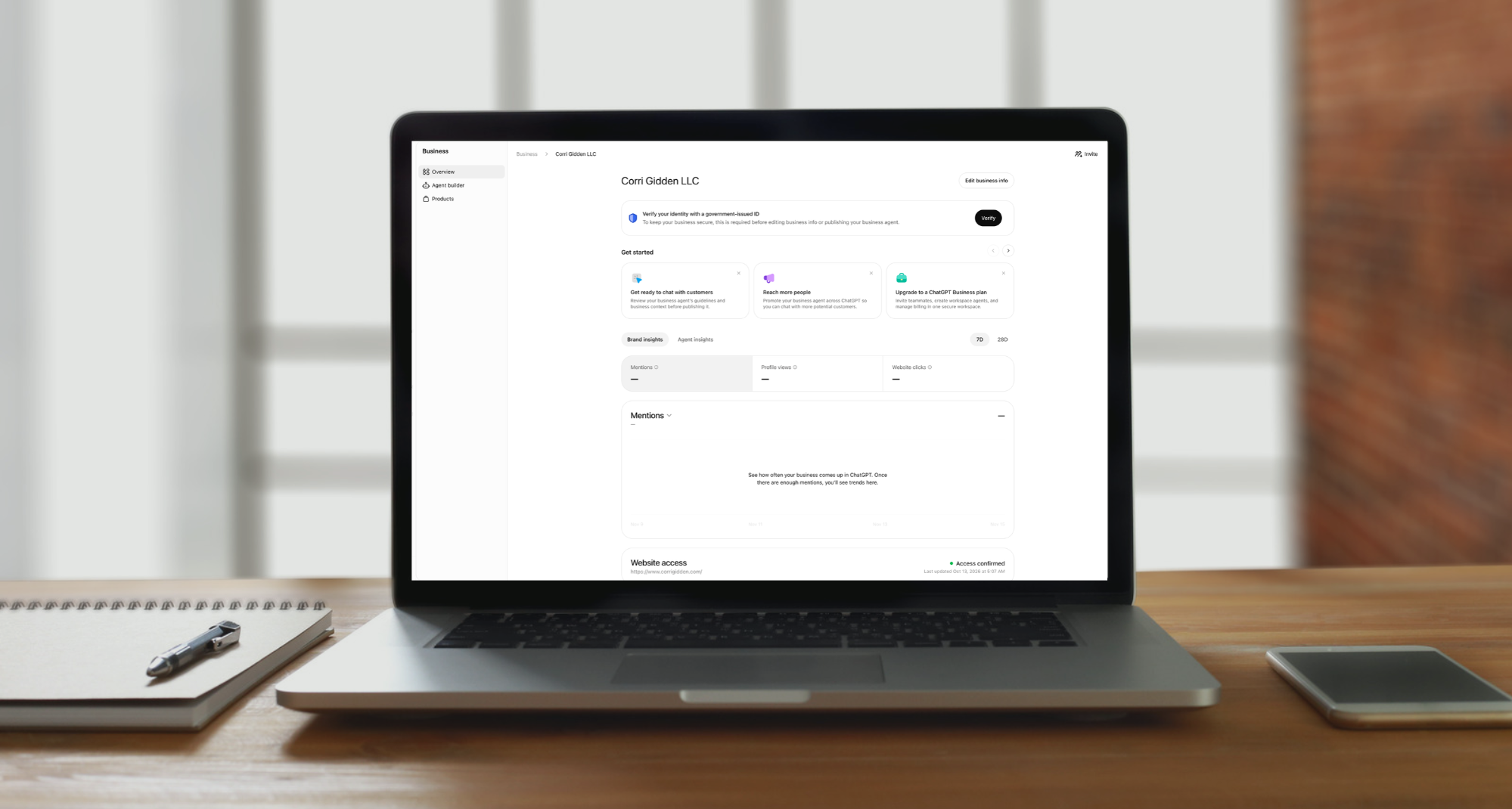
What Is ChatGPT Business Hub?
ChatGPT Business Hub is a place where eligible business owners or authorized representatives can claim and manage their business's presence in ChatGPT.
Think of it as a new business-management tool for an AI-powered discovery platform.
If you've ever claimed and managed a Google Business Profile, the general idea may sound familiar.
You verify that you're authorized to represent a business, provide accurate information, and manage certain details that people may encounter when looking for your company.
However, ChatGPT Business Hub is not the same as Google Business Profile, and it doesn't work exactly like a traditional business directory.
ChatGPT can generate answers using multiple sources of information, and a claimed profile doesn't give a business complete control over those answers.
Instead, Business Hub provides an additional way for businesses to contribute accurate information about themselves.
Depending on eligibility and verification status, businesses may be able to:
Claim an existing business profile or, in certain cases, add an eligible business.
Update information such as their website, business description, category, and logo.
Provide product information, including pricing and availability, through supported feeds.
View aggregated information about mentions and website clicks in ChatGPT.
See common discovery topics associated with their business.
Create a Business Agent, if their business qualifies.
OpenAI has introduced these features in beta, meaning availability and functionality may continue to change.
For business owners, the important takeaway is that ChatGPT is developing a more structured way for businesses to participate in how people discover and learn about them.
Why Should Business Owners Pay Attention?
Here's why I think this announcement matters.
For a long time, businesses have focused on being visible in places like Google Search, Google Maps, social media platforms, and online directories.
Those channels still deserve attention.
But when potential customers start using AI assistants to research options, compare services, and make decisions, businesses have another environment to consider.
Imagine someone asks ChatGPT:
"What should I consider when choosing a company to redesign my business website?"
The response might explain important considerations, suggest questions to ask, or help the person compare different approaches. In some situations, ChatGPT may also reference specific businesses or websites.
That creates another potential opportunity for a business to be discovered during a customer's research process.
And if someone encounters your business there, you want the information they find to be accurate.
That doesn't mean every business will suddenly receive inquiries through ChatGPT. It doesn't mean ChatGPT will recommend every claimed company. And it certainly doesn't mean traditional SEO is no longer necessary.
But it does mean business owners should start paying attention to how their organizations are represented across AI-powered discovery tools.
Why This Could Be Especially Important for Small and Medium-Sized Businesses
Large organizations often have dedicated marketing teams, established brand recognition, extensive websites, and resources for monitoring new platforms.
Smaller and medium-sized businesses may not have those same advantages.
A local service provider, independent retailer, or growing professional services company might have a limited marketing budget and an owner who already handles several different responsibilities.
That's one reason I see potential value in Business Hub.
1. Another opportunity to be discovered
A smaller company may not have the brand recognition of a national competitor.
But it may have specialized expertise, a strong local reputation, or a service that fits a customer's needs particularly well.
If AI-assisted discovery helps someone research that kind of service, the business has another potential opportunity to be considered.
This is an opportunity, not a promise of increased visibility.
2. More control over business information
Smaller businesses sometimes have outdated information scattered across websites and online listings.
Maybe a service has changed.
Maybe the business has updated its website.
Or perhaps an old description no longer accurately represents what the company offers.
A verified Business Hub profile gives an eligible business another way to provide current information.
That could be especially useful when the business doesn't have a large team monitoring its online presence.
3. New information about how people discover the business
One of the more interesting features is the ability to see aggregated insights about mentions, website clicks, and discovery topics.
For a business owner who already uses Google Analytics or Google Search Console, this provides another perspective on online discovery.
For example, a website designer might learn that their business appears in ChatGPT conversations involving website redesigns or SEO.
That could help inform future website content or marketing decisions.
These insights have limitations, which we'll discuss shortly, but they may still offer useful clues.
4. Potential customer assistance without a large support team
Eligible businesses may eventually benefit from Business Agents that answer common questions using information the business provides.
For a smaller online business, that could help customers find information about products, policies, or services without requiring someone to respond manually to every routine question.
However, Business Agents are currently restricted to eligible U.S. ecommerce and online service businesses. They're not universally available to every business that claims a profile.
5. An opportunity to pay attention early
I don't believe business owners need to jump on every new platform the moment it launches.
But when a major platform introduces a way to manage business information, it's worth understanding what it offers.
Even if Business Hub doesn't immediately become an important source of traffic or inquiries for your business, learning how it works now may help you make more informed decisions as it develops.
What About Larger Businesses and Organizations?
The potential benefits aren't limited to smaller companies.
Larger businesses may have additional reasons to pay attention.
A company with multiple locations, a large product catalog, or several service divisions has more information to keep accurate.
That creates opportunities, but also additional complexity.
For example, a national retailer may want current product prices and availability reflected accurately wherever its products are presented.
An organization offering several different services may want customers to understand which services are available and what each one includes.
A larger company may also have multiple departments responsible for marketing, ecommerce, customer support, and compliance.
In those situations, Business Hub could become another platform that needs clear ownership and consistent information management.
OpenAI has indicated that businesses with more complex needs will be part of future development, but owners should evaluate the capabilities currently available rather than assuming every enterprise requirement is already supported.
What Can You Actually Do Inside ChatGPT Business Hub?
Let's look more closely at the main features.
Claim and verify your business
Claiming establishes that you're authorized to manage a particular business profile.
Once the claim and required identity verification are approved, eligible businesses can manage supported information and access additional features.
It's important to understand that claiming a business and completing identity verification are separate stages.
Update your business information
Verified businesses can provide details such as their website, description, category, logo, and certain other information.
Depending on the business, supported fields may also include delivery and return policies, cover photos, and product information.
OpenAI reviews changes before publishing them.
And here's an important limitation:
Updating your profile doesn't mean every ChatGPT answer will immediately reflect those changes.
ChatGPT may also use other information sources when responding to questions.
View business insights
Business Hub includes an Insights area showing aggregated activity over the previous 28 days.
Available metrics include business mentions, website clicks, and discovery topics.
These insights can help businesses understand some of the ways they're appearing in ChatGPT.
But they're not a complete measurement of customer behavior, and they don't reveal every conversation involving your business.
Connect product information
Businesses selling products may be able to provide product feeds containing information such as prices and availability.
Supported methods include Shopify integration and product feeds that meet OpenAI's specifications.
This could be particularly relevant for ecommerce businesses where product details change regularly.
Create a Business Agent
Eligible U.S. ecommerce and online service businesses may be able to create a Business Agent.
A Business Agent is a separate, clearly identified conversational experience that uses information and instructions provided by the business to help answer customer questions.
For example, a customer might ask about a product, service, or return policy.
The business can review and test its agent before publishing it.
However, a Business Agent isn't the same as controlling ChatGPT's independent answers, and its availability depends on business eligibility.
How to Claim Your Business in ChatGPT: Step by Step
If you're interested in getting started, the claiming process is relatively straightforward, although verification and approval may require additional time.
Here are the steps based on OpenAI's current setup instructions.
Step 1: Open ChatGPT Business Hub
Sign in to your ChatGPT account.
From the sidebar, open Business Hub.
You can also start from OpenAI's official Businesses in ChatGPT page:
https://openai.com/business/businesses-in-chatgpt/
Look for the option to claim your business.
Step 2: Search for your business
Enter your business name in the search field.
If your business already has a listing, select the one that matches your company.
Make sure you're choosing the correct business, especially if other companies have similar names.
You'll also confirm the ChatGPT account you'll use to manage it.
What if your business isn't listed?
Eligible online businesses may see an option to add a new profile.
At launch, local stores and restaurants can claim existing U.S. listings but cannot necessarily create a missing local listing through the same process.
If you don't see an option to add your business, that doesn't automatically mean you're doing something wrong.
Availability depends on the business type, location, and current rollout.
Step 3: Choose a verification method
ChatGPT will display the verification methods available for your business.
Depending on the listing, these may include:
Business phone verification
Receive a code through a text message or automated call to the business phone number shown.
Business email verification
Receive a verification code at an email address associated with your business.
Website domain verification
Add a TXT record provided by ChatGPT to your domain's DNS settings.
This helps establish your connection to the website domain.
If someone else manages your domain, you may need their assistance.
Shopify verification
Eligible Shopify merchants can connect their stores through the supported integration.
You only need to follow one of the methods offered for your particular business.
Step 4: Submit your claim and wait for approval
After completing the required verification steps, OpenAI reviews the claim.
You should receive an email with the decision or a request for additional information.
Submitting the claim doesn't mean it's automatically approved.
Step 5: Complete identity verification with Persona
This is a step business owners should be prepared for.
After claim approval, OpenAI requires identity verification through Persona before you can publish business information changes, access insights, connect product feeds, or create an eligible Business Agent.
Depending on the circumstances, you may need to provide:
A government-issued identity document
Business registration information
Evidence that you're authorized to represent the business
Follow the instructions shown in Business Hub and wait for approval.
Once the required identity verification is approved, the business profile can receive a blue verified checkmark.
Step 6: Review and update your profile
After verification, review the information associated with your business.
Pay particular attention to:
Your official business name
Your website address
Your business description
Your service or product category
Your logo and other available branding
Relevant policies or product details
Make sure the information accurately reflects what your business currently offers.
Avoid exaggerated claims, outdated services, or descriptions that don't match your website.
Step 7: Explore your insights and available features
Once the required verification is complete, explore the Insights area.
Review available mentions, website clicks, and discovery topics.
If your business is eligible for a Business Agent or product feed, you can explore those options as well.
You don't need to activate every feature immediately.
Start by getting your business information right.
Then decide which additional features make sense for your business.
What If Someone Else Has Already Claimed Your Business?
If your business profile has already been claimed, OpenAI provides an ownership dispute process.
Open the business profile, select the three-dot menu, and choose Dispute ownership.
Follow the instructions to verify that you're authorized to represent the business.
If a listing is locked and displays Contact support, use that option for assistance.
This is also a good reminder to keep track of which accounts are authorized to manage important business platforms.
Just as with your website domain, Google Business Profile, or advertising accounts, ownership and access should be handled carefully.
The Potential Downsides and Limitations Business Owners Should Understand
Now let's discuss the part that I think is just as important as the exciting possibilities.
Because while Business Hub introduces useful features, there are several reasons not to treat it as an instant marketing solution.
1. Claiming your business doesn't guarantee recommendations
This is probably the most important limitation.
Claiming your business does not guarantee that ChatGPT will recommend it, rank it higher, or send customers to your website.
ChatGPT's independent recommendations and comparisons are separate from a business's ability to manage its profile.
A verified profile is not a shortcut to guaranteed AI visibility.
And businesses should be cautious of anyone selling services that promise otherwise.
2. You don't control everything ChatGPT says about your business
Even after you've provided accurate information, ChatGPT may use other sources when answering questions.
That means outdated information elsewhere online can still matter.
Your website, public business listings, and other reliable sources of information remain important.
Business Hub is another part of your online presence, not a replacement for maintaining the rest of it.
3. Not every business can access every feature
Business Hub is in beta.
Eligibility depends on factors including location, business type, and verification requirements.
Business Agents currently have narrower eligibility than basic business claiming.
Some businesses may be able to claim and manage a profile without having access to an agent.
4. Insights don't tell the whole story
A business mention isn't necessarily a customer inquiry.
A website click isn't necessarily a purchase.
And a discovery topic doesn't reveal exactly what an individual customer wanted.
OpenAI also applies privacy thresholds to its reporting, so some metrics may not appear when there isn't enough qualifying activity.
A blank metric doesn't necessarily mean nobody has encountered your business.
Business owners should use these insights as additional information rather than treating them as a complete picture of marketing performance.
5. Verification and maintenance require attention
Like any business platform, Business Hub introduces another account and another set of information to manage.
Someone needs to maintain accurate details, review changes, and monitor available insights.
For smaller businesses with limited time, that's worth considering.
A new marketing tool is only useful if the effort required to maintain it makes sense for the business.
6. Customer privacy and information accuracy still matter
Business Agents can answer questions based on information a business provides, but that information needs to be accurate and appropriate to share.
Businesses should be careful about confidential information, customer data, sensitive claims, and policies.
OpenAI says businesses receive aggregated insights rather than individual ChatGPT conversations or Business Agent chats.
That's an important privacy protection, but businesses should still review their own data-handling practices before connecting systems or providing information.
7. It could become another distraction from marketing fundamentals
This connects directly to something I've discussed in my recent articles about AI and marketing.
It's easy to become excited about a new platform and start treating it as the next big solution to every marketing problem.
But if your website is confusing, your services aren't clearly explained, or your marketing doesn't connect with the right audience, claiming another profile won't fix those issues.
A strong online presence still starts with clear information, useful content, and a dependable customer experience.
Does This Mean Traditional SEO Is Becoming Less Important?
No. At least, that's not the conclusion I would draw.
If anything, this development is another reminder that businesses need to think about how their information is discovered and understood across different platforms.
Traditional SEO still helps make website content accessible, relevant, and understandable to search engines.
Clear page structure, useful content, accurate business details, and a well-organized website can also support broader online discoverability.
But it's important not to confuse good practices with guaranteed results.
There is no single setting, schema markup type, or business verification step that guarantees placement in ChatGPT answers.
Instead of abandoning SEO to chase AI visibility, I recommend thinking about the bigger picture.
Your website should explain what you do.
Your content should answer real customer questions.
Your business information should be consistent and current.
Your brand should give people a reason to remember you.
And your marketing should make it easy for interested visitors to take the next step.
Those fundamentals remain valuable whether someone discovers your business through Google, social media, a referral, or an AI assistant.
What Should Businesses Do Right Now?
You don't need to overhaul your entire marketing strategy because Business Hub has launched.
But I do think it's worth taking a few practical steps.
First, check whether your business can be claimed
Visit Business Hub and search for your business.
If you're eligible, consider completing the claiming and verification process.
Second, review the information already available about your business
Make sure your website and important public profiles accurately reflect your current services, products, location, and contact information.
Third, improve your website's most important pages
Review your homepage, service pages, product pages, and contact page.
Ask whether a first-time visitor can understand what you offer and how to get started.
Fourth, create content around real customer questions
Pay attention to the questions people ask before choosing your products or services.
Use those questions to guide helpful website content.
Fifth, monitor the information that matters
If Business Hub provides insights for your business, review them alongside your other marketing data.
Look for useful patterns, but don't assume that every mention or click represents a qualified lead.
Finally, keep your expectations realistic
This is a new platform feature.
Its capabilities and importance may change over time.
Learn what it offers, make informed decisions, and avoid treating early possibilities as guaranteed business results.
Frequently Asked Questions About ChatGPT Business Hub
Is ChatGPT Business Hub free?
OpenAI's current claiming documentation does not require a ChatGPT Enterprise agreement or advertising account to claim an eligible business. Business Agent eligibility and any future commercial terms should be checked against the latest official information.
Do I need ChatGPT Enterprise to claim my business?
No. Eligible businesses do not need a ChatGPT Enterprise agreement to claim a profile. Existing Enterprise customers may have additional support through their OpenAI representatives.
Can I claim my business if I don't use Shopify?
Yes. Shopify is one supported verification and integration option, but it isn't required for all eligible businesses.
What if my business doesn't appear in the search results?
Eligible online businesses may have an option to add a profile. Some local business categories can currently claim only existing U.S. listings. If no creation option appears, check OpenAI's latest eligibility information.
Will claiming my business make it appear more often in ChatGPT?
Not necessarily. Claiming allows you to manage supported information, but it doesn't guarantee more mentions, higher placement, recommendations, or sales.
Can ChatGPT mention my business even if I haven't claimed it?
Yes. ChatGPT may reference businesses that haven't claimed a Business Hub profile. Claiming isn't a prerequisite for every business mention.
What is a ChatGPT Business Agent?
A Business Agent is an optional feature for eligible businesses that allows customers to ask questions using information and instructions supplied by the business. At launch, availability is limited to eligible U.S. ecommerce and online service businesses.
Can I see what customers are asking ChatGPT about my business?
Not their individual conversations. Business Hub provides aggregated insights, including mentions, website clicks, and discovery topics, subject to privacy thresholds.
Is this the same as Google Business Profile?
No. Both involve managing business information, but they operate within different platforms and have different features, eligibility requirements, and discovery experiences.
Should every business claim its ChatGPT profile?
I think it's worth checking eligibility and understanding the opportunity. Whether claiming and actively managing a profile should become a priority depends on your business, audience, resources, and marketing goals.
Final Thoughts: Another Opportunity, Not a Marketing Shortcut
I think ChatGPT Business Hub is an interesting development for businesses.
It gives eligible organizations a new way to manage information about themselves, understand some of the ways they're being discovered, and potentially help customers explore their products or services.
For smaller businesses, especially those without large marketing teams, that could become a useful opportunity.
For larger organizations, it introduces another platform to consider as part of a broader digital presence.
But I also think it's important to keep the excitement in perspective.
Claiming your business doesn't replace a good website.
It doesn't replace useful content.
It doesn't replace understanding your customers.
And it certainly doesn't guarantee that AI will start recommending your company.
Being present on a new platform is one thing. Giving people a good reason to choose your business is another.
My recommendation is simple: Learn about Business Hub, claim your business if you're eligible, keep your information accurate, and pay attention to how the platform develops.
But don't lose sight of the marketing fundamentals that make your business worth discovering in the first place.
Because whether someone finds you through a traditional search engine, social media, or ChatGPT, the goal is still the same.
Help the right people understand what you offer, why it matters, and how to take the next step.
Is Your Business Ready for the Way People Search Today?
At Corri Gidden LLC, I help businesses and organizations build stronger online foundations through custom website design, SEO, digital marketing strategy, and content development.
From improving your website's structure and content to helping your business communicate more clearly with potential customers, my focus is on practical marketing that supports your goals.
Based in North Texas and serving clients nationwide.
Visit Corri Gidden LLC to explore my services and get in touch.
Official Resources
For the most current information about eligibility, verification, and features, refer to OpenAI's official resources:
Information current as of November 17, 2026. ChatGPT Business Hub is in beta, and features, availability, and verification procedures may change.